Property Deal Sheet
A Fast First Read on if a Property is Worth Pursuing
Try the ToolProof of Concept
Format
AI Platform Comparison
Focus
2
Inputs
4 Metrics
Live Outputs
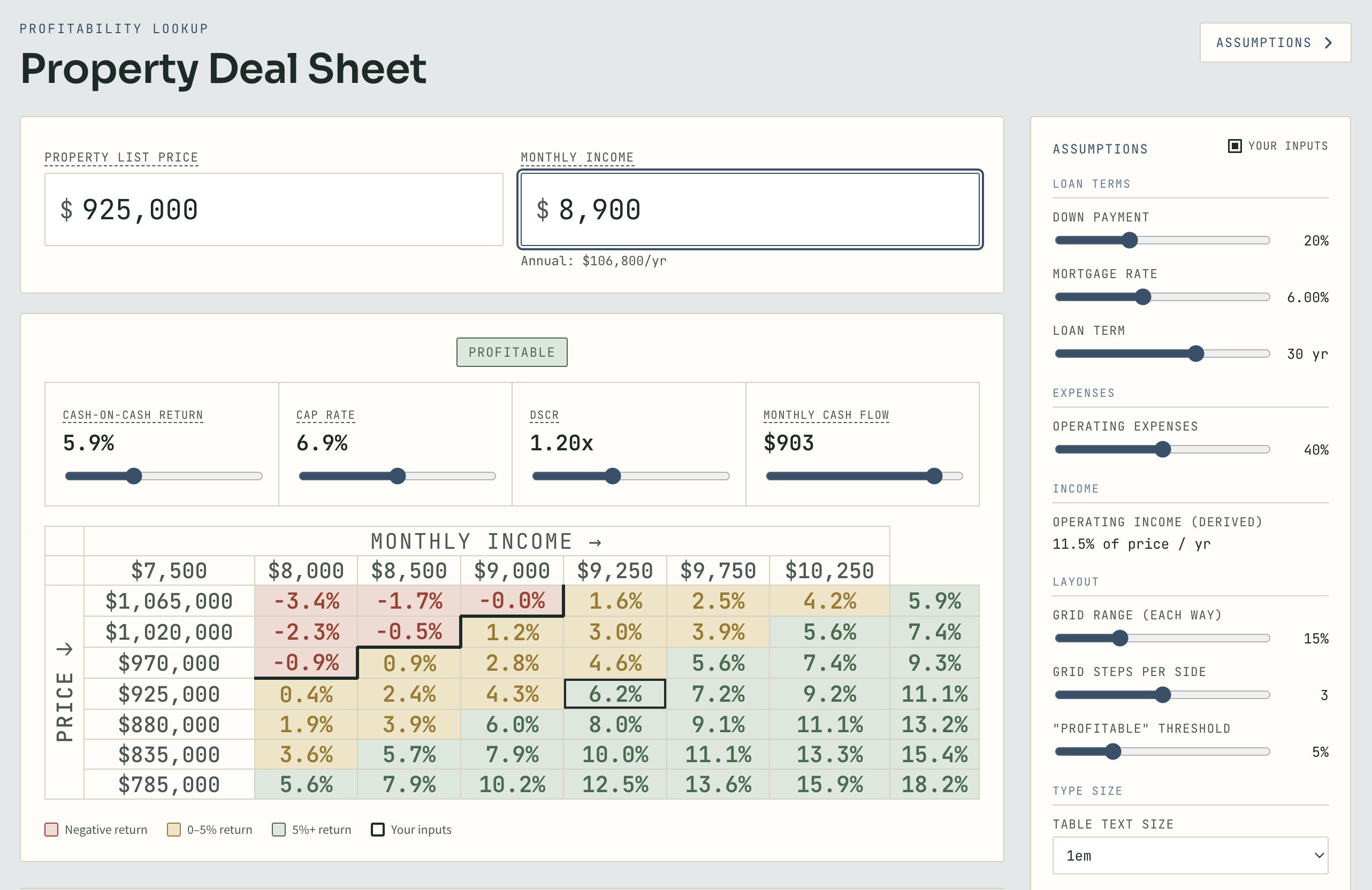
Overview
Real estate investors use dozens of methods to evaluate a deal, but a few tried-and-true questions can tell you almost immediately whether it's worth a closer look:
- →Does the property generate positive monthly cash flow?
- →Based on comparable sales, what's the cap rate at this purchase price?
- →Would this money earn a better return somewhere else? (cash-on-cash return)
The Problem
There are a lot of moving parts to analyze before purchasing real estate — a process known as underwriting. But before running a full analysis, investors need a faster, back-of-the-napkin way to tell whether a property is worth pursuing at all.
The starting point is simple: will this property make money? From there, the goal was to:
- →Start from two inputs — price and income — and estimate the rest
- →Make the relationship between price, income, and returns easy to see at a glance
- →Let investors adjust assumptions and immediately see how the numbers move
Key Insight
A property either clears the bar or it doesn't — and investors want to know which in seconds, not spreadsheets.
- →Time is the real constraint; most deals get screened before anyone opens a full underwriting model
- →Investors think in outcomes — cash flow up, returns up — not in financial models
- →A fast first pass determines whether deeper underwriting is worth the time at all
About This Build
This tool doubles as a proof of concept. Rather than build another throwaway demo, I used a real underwriting question as the test case to compare several AI-assisted ("vibe-coding") development platforms and design systems against each other — the same tool, built more than once, to see how each platform's defaults, constraints, and design language actually held up.