Kaiser
Reimagining Home-Based Care Delivery (Focus Home)
1.4M
Potential member candidates
7×
Addressable population expansion
4
System layers designed
Phased
Rollout strategy
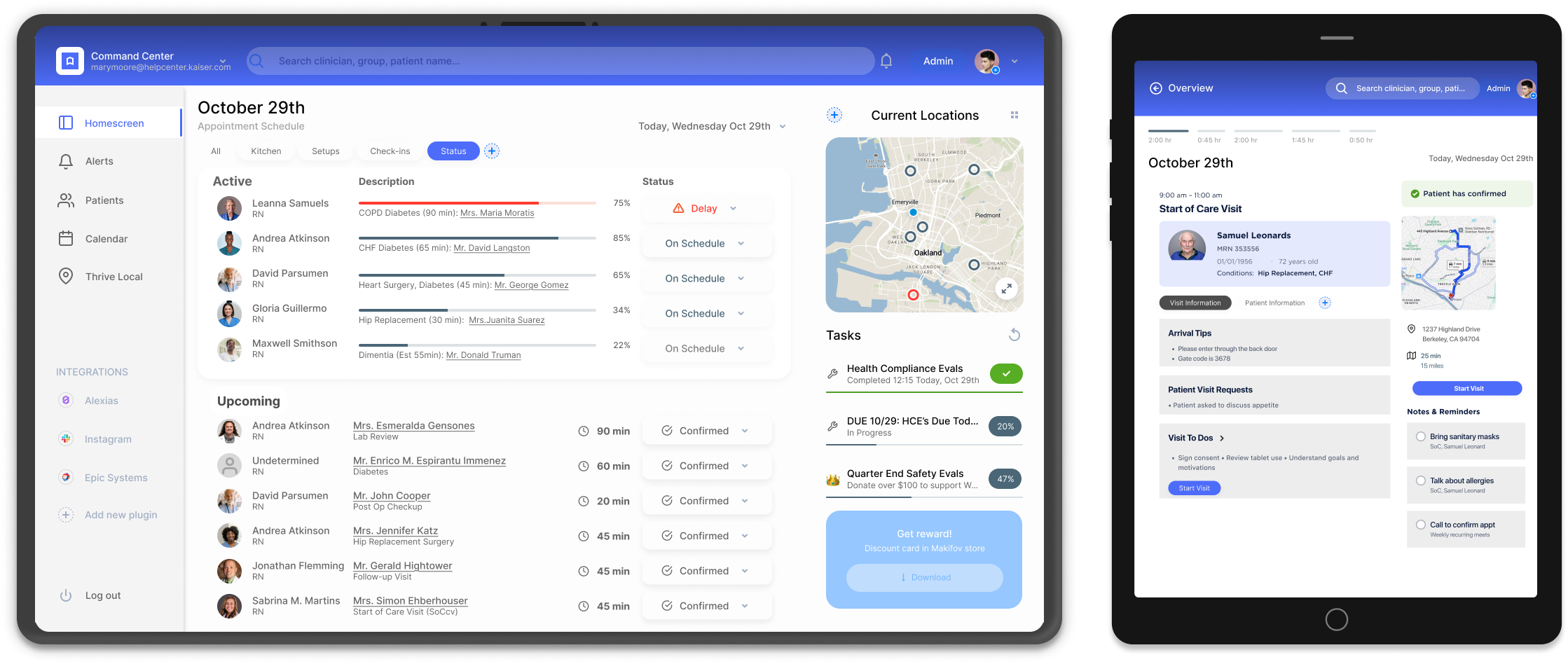
Overview
Contributed to the development of Focus Home, a future-state care model at Kaiser Permanente designed to shift care delivery from hospitals and clinics into patients homes.
The initiative explored how an interconnected system of services, technology, and operations could deliver more personalized, timely, and scalable care.
The Problem
Traditional healthcare delivery is centralized, reactive, and resource-intensive.
- →Care is primarily delivered in clinics and hospitals
- →High-need patients require continuous, coordinated support
- →Existing systems are fragmented across services and touchpoints
- →Scaling home-based care is operationally complex
Key Insight
Improving care delivery is not a single product problem—it's a system design challenge.
We identified that:
- →Care must extend beyond episodic visits into continuous engagement
- →Value emerges from connecting services, not optimizing them in isolation
- →High-need patients are the most impactful starting point for validation
- →Scale requires sufficient member density to support operational efficiency
Approach
Vision to System Design
Translated a future-state vision into a structured system:
- ·Defined key components across care delivery, engagement, and technology
- ·Mapped how these components interact to support patient needs over time
Ecosystem Modeling
Designed an interconnected framework that enables:
- ·Coordinated care across multiple services
- ·Real-time responsiveness to patient conditions
- ·Continuous engagement beyond clinical settings
Proof of Concept (POC)
Developed a phased approach to validate the model:
- ·Initial focus on high-need patients already receiving home care
- ·Iterative refinement of workflows and operational efficiency
- ·Expansion toward broader patient populations over time
System Thinking
Focus Home operates as a connected system:
As these components integrate, the system enables more proactive and personalized care, improved coordination across touchpoints, and scalable delivery beyond traditional facilities.
Impact
1.4M
members identified as potential candidates in early phases
7×
expansion of addressable population vs current home health capacity
Phased
rollout strategy established for operational feasibility
Aligned
stakeholders around a validated direction for future investment
Organizational Impact
The initiative also served as a catalyst for internal alignment:
- →Positioned Focus Home as a validated direction for future investment
- →Supported continued funding discussions and product development
- →Helped stakeholders align on next steps for scaling the model
Strategic Value
This initiative reframed care delivery from a location-based model to a system-based model, helping:
- →Align stakeholders around a shared future-state vision
- →De-risk large-scale transformation through phased validation
- →Connect clinical, operational, and technology strategies
- →Advance the program as a viable candidate for continued funding and expansion
Key Takeaways
- →Complex service problems require system-level design, not feature design
- →Value emerges from integration, not individual components
- →Starting with high-need users accelerates learning and impact
- →Scale depends on aligning user needs with operational feasibility
- →Early system validation can drive alignment, funding, and organizational momentum